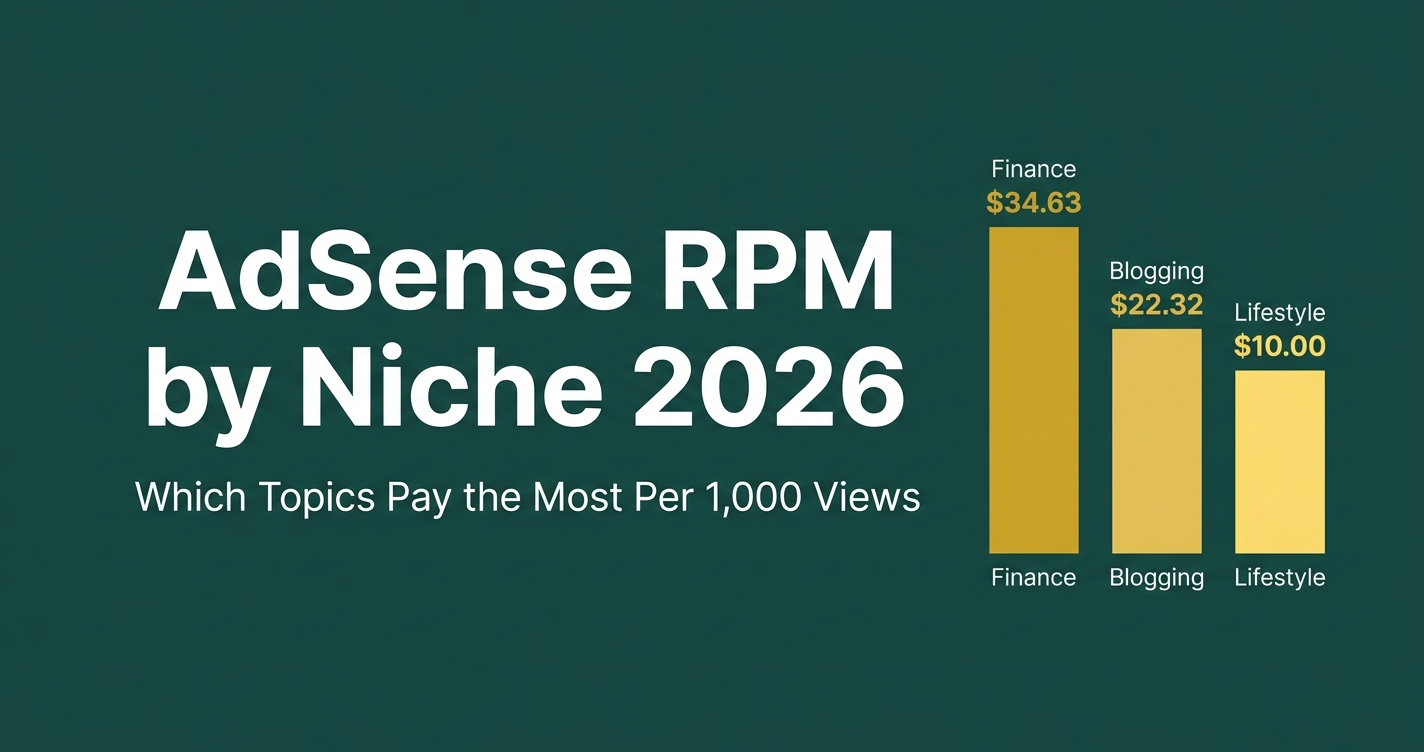
Finance and insurance blogs earn the highest AdSense RPM in 2026 — between $12 and $45 per 1,000 views. Legal, health, and technology content follow. Entertainment and general blogs earn the least, typically $0.50 to $2 RPM. Your niche determines up to 70% of your AdSense earnings — here is the full breakdown.
If you have been running a blog for more than a month, you have probably asked yourself why some bloggers earn $20 per 1,000 pageviews while yours earns $2. The answer almost always comes down to one metric: AdSense RPM by niche 2026— Revenue Per Mille, meaning how much you earn per 1,000 impressions based on the topic you write about.
RPM is not random. It is driven almost entirely by your niche, your audience’s country, and how close your content is to a commercial buying decision. Understanding AdSense RPM by niche 2026 — when ad budgets have shifted significantly post-AI — is the difference between a site that earns beer money and one that earns a real income.
This post breaks down average AdSense RPM by niche, shows you which countries your traffic should come from, and gives you five proven ways to increase your RPM starting this week. Use the AdSense Revenue Calculator to model what your own site could realistically earn.
What Is AdSense RPM and How Is It Calculated
RPM stands for Revenue Per Mille — “mille” being Latin for thousand. It tells you how much revenue your site earns for every 1,000 pageviews, regardless of how many ads are on the page.
The formula is simple:
RPM = (Total AdSense Earnings ÷ Total Pageviews) × 1,000
According to the Google AdSense Help Center, RPM is one of the key metrics publishers should track alongside CTR and CPC to understand true page performance.
So if you earned $15 from 3,000 pageviews in a day, your RPM is $5.
RPM is different from CPC (Cost Per Click). CPC is what an advertiser pays per click. RPM is what you actually receive per 1,000 views — it factors in both your click-through rate and the CPC of the ads showing on your page. Two sites with identical traffic can have wildly different RPMs based entirely on niche. According to Google’s own AdSense Help Center, your RPM is influenced by your ad placement, content quality, audience location, and the advertisers competing for your content category.
AdSense RPM by Niche in 2026
Here is a breakdown of average AdSense RPM ranges across major blogging niches in 2026. These figures are based on aggregated publisher data and industry reporting. Individual results will vary depending on content type, audience geography, and ad placement quality.
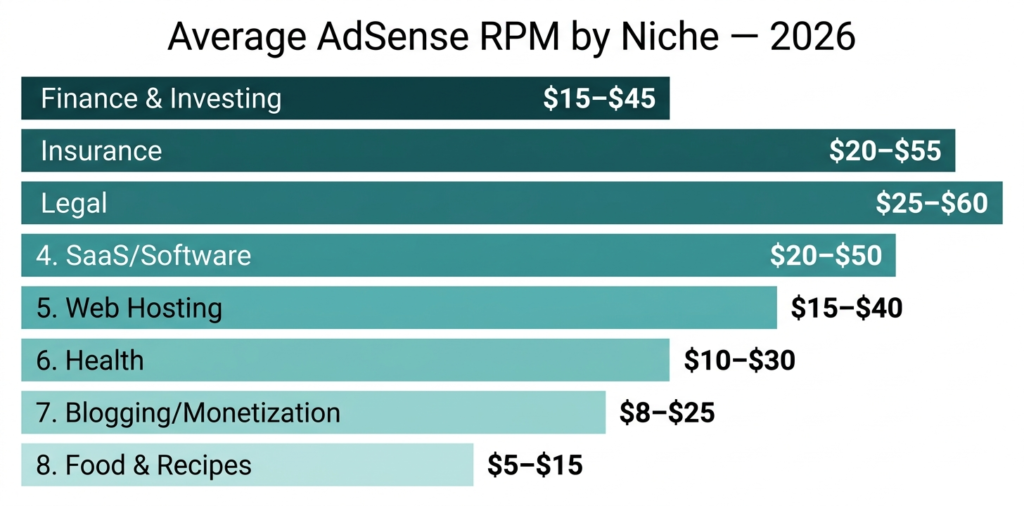
| Niche | Average RPM (USD) | Why It Pays High/Low |
|---|---|---|
| Finance & Investing | $15 – $45 | Advertisers pay premium CPC for high-intent buyers |
| Legal | $12 – $38 | Law firms and legal services have huge ad budgets |
| Insurance | $14 – $40 | Extremely competitive CPC category |
| Software / SaaS | $10 – $28 | B2B SaaS companies target this content heavily |
| Web Hosting / Tech | $8 – $22 | Hosting affiliates drive CPC up even on display ads |
| Health & Medical | $6 – $18 | High CPC but more Google content restrictions |
| Real Estate | $8 – $20 | Local intent + high transaction value = premium ads |
| Blogging / Monetization | $5 – $14 | Advertisers target aspiring earners (this niche) |
| Education & E-Learning | $4 – $12 | Growing category, still building advertiser competition |
| Travel | $3 – $10 | High traffic potential but lower CPC post-COVID recovery |
| Food & Recipes | $2 – $6 | Massive traffic but low commercial intent |
| Entertainment / Memes | $0.50 – $2 | Low intent, brand-unsafe concerns, minimal advertiser interest |
| General Lifestyle | $1.50 – $5 | No clear advertiser category = no premium pricing |
The blogging and monetization niche earns $5–$14 RPM. That is firmly in the mid-tier, which is significantly better than lifestyle or entertainment, and good enough to build a meaningful income with 30,000–80,000 monthly pageviews. Run those numbers yourself using the AdSense Revenue Calculator.
What Is a Good AdSense RPM for a Blog in 2026
A “good” RPM depends entirely on your niche, but here is a practical benchmark:
- Under $2 RPM: Your content has low commercial intent, your audience is from low-CPC countries, or your ad placement needs work.
- $2–$5 RPM: Average for most general blogs. Acceptable, but improvable.
- $5–$10 RPM: Good. You are in a mid-tier niche with decent US/UK traffic.
- $10–$20 RPM: Excellent. Finance, legal, SaaS, or hosting niches with strong Tier 1 traffic.
- $20+ RPM: Top tier. Usually specialized finance, insurance, or legal content with very high CPC keywords.
For a new site in 2026, targeting $4–$8 RPM in Month 3 is a realistic goal. If you are in the blogging or tool niche with a clean, fast site, $6–$10 RPM is achievable within six months as your audience quality improves and your content climbs search rankings.
AdSense RPM by Country: Where Your Traffic Comes From Matters More Than You Think
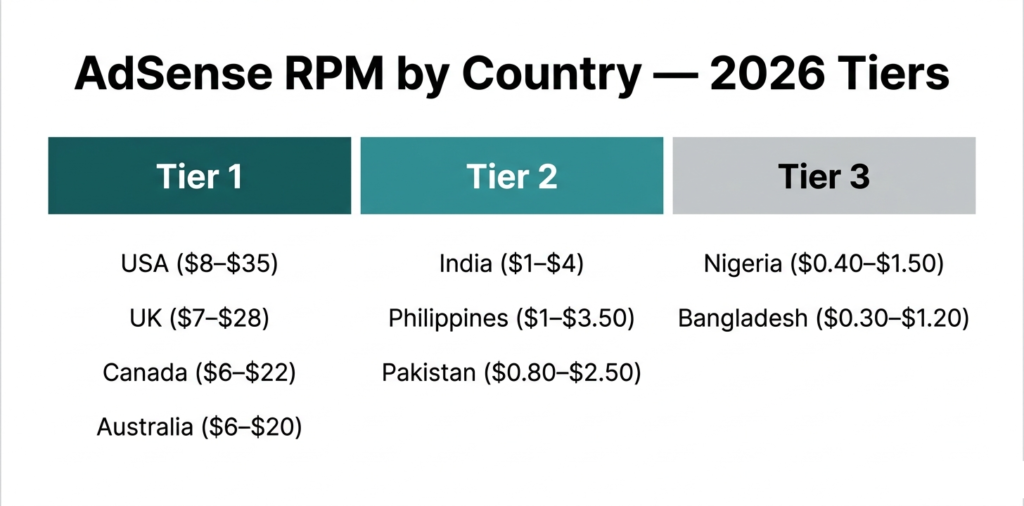
Niche is one half of the RPM equation. Country is the other half. An advertiser paying $4 CPC in the United States may only bid $0.30 for the same keyword in Pakistan or Nigeria. This is because advertisers follow purchasing power and conversion probability.
Here is how RPM typically breaks down by traffic source country in 2026:
| Country | RPM Tier | Typical RPM Range (USD) |
|---|---|---|
| United States | Tier 1 | $8 – $35+ |
| United Kingdom | Tier 1 | $7 – $28 |
| Canada | Tier 1 | $6 – $22 |
| Australia | Tier 1 | $6 – $20 |
| Germany | Tier 1 | $5 – $18 |
| Netherlands | Tier 1 | $4 – $15 |
| Singapore | Tier 2 | $3 – $10 |
| India | Tier 2 | $1 – $4 |
| Philippines | Tier 2 | $1 – $3.50 |
| Pakistan | Tier 2 | $0.80 – $2.50 |
| Nigeria | Tier 3 | $0.40 – $1.50 |
| Bangladesh | Tier 3 | $0.30 – $1.20 |
This is why two blogs with identical pageview counts can have 10x different AdSense earnings. A blog getting 50,000 visits from the United States can out-earn a blog getting 500,000 visits from Southeast Asia.
The goal for any English-language tool or blogging site in 2026 should be to attract Tier 1 traffic by targeting English-language search queries that are primarily searched in the US, UK, Canada, and Australia. Use the AdSense Revenue Calculator to model earnings by country so you can see exactly how much your traffic mix affects your bottom line.
Why Is My AdSense RPM Low
This is one of the most searched questions among bloggers — and it has specific, fixable answers.
Your content has no commercial intent. If you write about general lifestyle topics, recipes, or entertainment, advertisers in high-CPC categories simply will not bid on your pages. There is nobody willing to pay $3–$5 per click for your traffic. The fix is to pivot your content toward topics where readers are close to spending money — comparing tools, evaluating software, or researching before a purchase.
Most of your traffic comes from Tier 2 or Tier 3 countries. Even perfect content in a high-CPC niche earns low RPM if your visitors are from countries where advertisers pay low CPC. This is not something you can fully control, but you can tilt it by writing in English, targeting US-centric search queries, and building backlinks from English-language domains.
Your ad placement is inefficient. Ads buried below the fold, inside walls of text, or placed where users ignore them get low viewability scores. Google’s algorithm pays less for ads with low viewability. Moving one ad unit to just below your tool output or just after your introduction can increase viewable impressions significantly.
You do not have enough page authority yet. New sites with low Domain Rating show lower-quality ads simply because Google’s ad system has not gathered enough data about your audience. RPM typically increases 30–60% between Month 2 and Month 6 on a new site as Google’s system calibrates your audience profile.
Your site is slow. Ads on slow-loading pages often fail to render before the user leaves. Google measures this. A PageSpeed score below 70 on mobile can measurably reduce your effective RPM even if the ads technically load. Google’s PageSpeed documentation confirms that ad viewability is directly tied to page load speed.
Google’s own PageSpeed Insights tool shows you exactly which elements are slowing down your ad load time — check your tool pages there first
5 Ways to Increase Your AdSense RPM in 2026
1. Write content that targets buyers, not browsers
The single biggest RPM lever is content intent. A post titled “Best WordPress Hosting for Bloggers 2026” attracts readers who are actively evaluating a $100–$200/year purchase. A post titled “10 Blogging Tips” attracts casual readers with no buying intent. Both can get the same traffic. Only one earns $12+ RPM.
Map every piece of content you write to a commercial intent query — comparisons, reviews, calculators, tutorials for paid tools, and monetization guides all perform better than general informational content.
2. Place one ad unit immediately below your tool or primary content output
The highest-performing ad position on a tool site is directly below the tool output — where the user has just engaged with the tool and is in a receptive, satisfied mindset. This placement consistently outperforms top-of-page leaderboards on tool pages. Test this on your highest-traffic tool page first.
3. Enable Auto Ads but limit them to 3 maximum
Google Auto Ads use machine learning to find optimal placements. But more ads is not always more money — page experience degrades, users leave faster, and Google penalizes sites with intrusive ad experiences. Set a maximum of 3 ad units per page and let Auto Ads fill the best positions within that limit.
4. Attract more US and UK traffic by writing about US-specific topics
Content that references US-specific context — FTC rules, IRS thresholds, US-based tools, dollar-denominated examples — naturally ranks better for US searchers and draws higher-CPC traffic. For a blogging tool site, writing about FTC disclosure requirements or AdSense payment thresholds in dollars signals US relevance to both Google and advertisers.
5. Use your AdSense data to double down on your highest-RPM pages
Your AdSense dashboard shows RPM by page. Identify your top 3 RPM pages and write 3–4 more pieces of content closely related to those topics. Internal linking between them builds topical authority and sends more of your audience to your highest-earning pages. Use the AdSense Revenue Calculator to project what happens to your monthly earnings if you increase traffic to your top RPM page by 50%.
How Much Can You Realistically Earn with AdSense in 2026
Let us put the numbers together for a mid-tier blogging and tools niche site targeting primarily US and UK traffic:
- 30,000 monthly pageviews × $6 RPM = $180/month
- 50,000 monthly pageviews × $7 RPM = $350/month
- 80,000 monthly pageviews × $8 RPM = $640/month
- 100,000 monthly pageviews × $9 RPM = $900/month
These are conservative figures for a clean, fast site in the blogging/monetization niche with majority Tier 1 traffic. Finance or SaaS content at the same traffic levels would earn 2–3x more.
The path to $500+/month in AdSense on a new site in 2026 is 12–18 months of consistent content publishing, strong on-page SEO, and a niche with genuine advertiser demand. The model is entirely repeatable and verifiable, which is why tool sites in this category sell for 28–35x monthly earnings on Flippa.
Model your own projections with different traffic and niche combinations using the AdSense Revenue Calculator — it shows daily, monthly, and yearly estimates so you can set realistic goals from Day 1.
The Bottom Line
AdSense RPM by niche in 2026 is driven by three things: your topic, your audience’s geography, and how well your ad placements capture viewable impressions. Finance and legal content earns the most. US and UK traffic earns the most. A fast, clean site with well-placed ads earns the most.
If you are in the blogging and monetization space, $5–$12 RPM is an achievable and realistic target. Focus on commercial-intent content, Tier 1 traffic acquisition through English-language SEO, and systematic ad placement testing. The RPM will follow.
Published by QuickBLOGTOOL.com — Free Tools for Bloggers, No Signup Required.
Frequently Asked Questions
Which niche pays the highest AdSense RPM?
Finance and insurance is the highest-paying AdSense niche in 2026, with RPMs ranging from $12 to $45 per 1,000 views. Legal content comes second ($10–$35 RPM), followed by health and medical ($8–$20 RPM). These niches pay more because advertisers in these industries have higher customer lifetime values and pay more per click.
What is the average AdSense RPM for a blogging niche site?
A blogging, digital marketing, or SEO niche site targeting US and UK traffic typically earns $3–$8 RPM in 2026. This assumes a well-optimized site with good ad placement and at least 60% Tier 1 (US/UK/AU) traffic. Sites with mostly Indian or Pakistani traffic in the same niche will see $0.50–$2 RPM due to lower CPC bids from advertisers.
Does AdSense RPM change by country even in the same niche?
Yes, significantly. A finance blog with US traffic can earn $15–$45 RPM. The same finance blog with primarily Indian traffic earns $1–$4 RPM. Country affects RPM more than almost any other factor because advertisers set their bids in local currency targeting local audiences. Use our AdSense Revenue Calculator to see the difference by country for your niche.
Can I switch niches to increase my AdSense RPM?
Yes, but it is a major commitment. Switching niches means creating new content, building topical authority from scratch, and waiting months for rankings to recover. A faster approach is to add high-CPC content within your existing niche — for example, a general tech blog can add finance software reviews or SaaS comparisons to attract higher-paying ads without abandoning the existing audience.
What is a good RPM for AdSense?
A good RPM depends on your niche and traffic source. As a benchmark: under $1 is low, $1–$3 is average, $3–$8 is good, $8–$15 is excellent, and $15+ is top tier. Most new bloggers start at $1–$3 RPM and improve as they attract more US traffic and optimise ad placement over time.