Does AdSense pay per view or per click? The answer is both — but they work very differently. AdSense pays a small amount per 1,000 ad impressions (CPM) and a larger amount each time a visitor clicks an ad (CPC). For most publishers, 70–80% of total AdSense earnings come from clicks. This guide explains exactly how each payment type works, what rates to expect in 2026, and what you can do today to earn more from both.
How AdSense Pays You: The 3 Metrics You Must Know
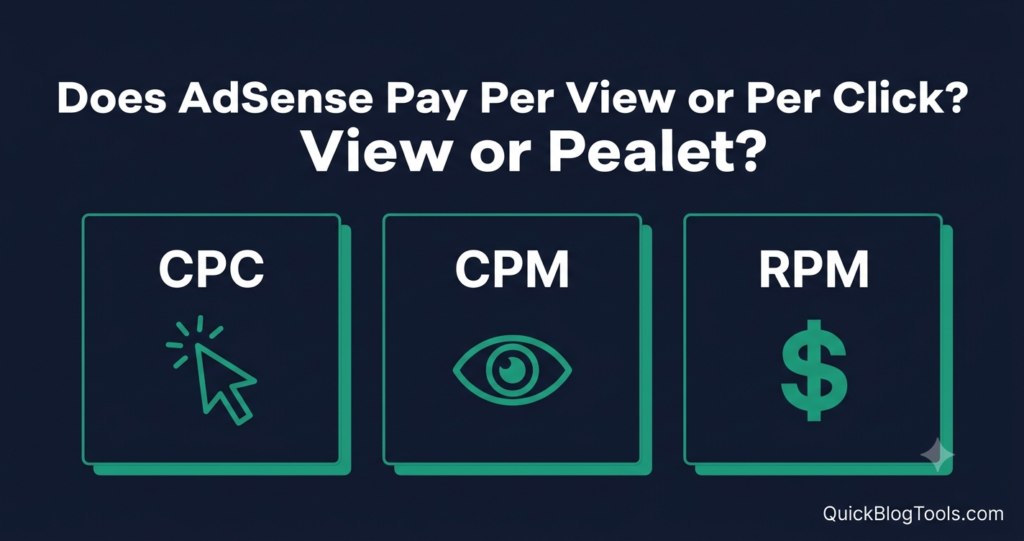
Before getting into rates, you need to understand three terms. Every AdSense publisher sees these in their dashboard and confuses them at first:
| Term | Stands For | What It Means | Typical Range |
|---|---|---|---|
| CPC | Cost Per Click | What an advertiser pays Google each time someone clicks their ad. You receive ~68% of this. | $0.10 – $20 per click |
| CPM | Cost Per Mille (1,000) | What an advertiser pays per 1,000 ad impressions, whether clicked or not. | $0.30 – $5 per 1,000 |
| RPM | Revenue Per Mille | Your actual earnings per 1,000 page views, combining both clicks and impressions. | $1 – $45 depending on niche |
RPM is the number that actually matters for your bank account. CPC and CPM are inputs — RPM is the output. Your AdSense dashboard shows all three, but RPM is what tells you how much your traffic is actually worth.
Does AdSense Pay Per View? (CPM Explained)
Yes — AdSense pays a small amount per view through CPM ads, but the amount is much smaller than click earnings. CPM ads pay you whenever an ad is displayed 1,000 times, regardless of whether anyone clicks. The typical CPM rate for a general blog is $0.30 to $2 per 1,000 ad impressions.
Here is a realistic example of CPM earnings:
| Monthly Page Views | Ads Per Page | Total Ad Impressions | CPM Rate | CPM Earnings |
|---|---|---|---|---|
| 10,000 | 3 | 30,000 | $1.00 | $30 |
| 50,000 | 3 | 150,000 | $1.00 | $150 |
| 100,000 | 3 | 300,000 | $1.50 | $450 |
CPM earnings alone are modest. The real money comes when you combine CPM income with click (CPC) income — which is why your effective RPM is always higher than CPM alone.
Does AdSense Pay Per Click?
So does AdSense pay per view or per click more? Clicks are where most AdSense revenue comes from. When a visitor clicks an ad on your site, Google pays you approximately 68% of what the advertiser paid for that click. The other 32% goes to Google.
For example: if an advertiser pays Google $2.00 for a click in the finance niche, you receive approximately $1.36 from that single click. If an advertiser pays $0.50 for a click in a general blog niche, you receive around $0.34. This 68% revenue share is confirmed in Google’s official AdSense revenue share policy.
This is why your niche matters so much. Here are typical CPC ranges by content category:
| Niche | Advertiser CPC | Your Share (~68%) |
|---|---|---|
| Finance / Insurance | $5 – $30 | $3.40 – $20.40 |
| Legal | $4 – $20 | $2.72 – $13.60 |
| Health / Medical | $2 – $10 | $1.36 – $6.80 |
| Technology / SaaS | $1.50 – $8 | $1.02 – $5.44 |
| Blogging / Marketing | $0.80 – $4 | $0.54 – $2.72 |
| Entertainment | $0.10 – $0.80 | $0.07 – $0.54 |
Even one click per day in a high-CPC niche can be worth $1–$5. At scale, CPC earnings dwarf CPM earnings for almost every publisher. See exactly how much your traffic could earn using our free AdSense Revenue Calculator.
CPC vs CPM vs RPM: Which Matters Most?
When you ask “does AdSense pay per view or per click”, the real answer is: both feed into your RPM. RPM is the only number that actually measures how much your site earns. CPC and CPM are the two inputs that combine to produce your RPM. Your goal as a publisher is to maximise RPM — not to chase a high CPC or CPM in isolation.
RPM is calculated like this:
RPM = (Total Earnings ÷ Total Page Views) × 1,000
A site with a $2 CPC but a 5% CTR (click-through rate) earns the same RPM as a site with a $10 CPC but a 1% CTR. Both produce a $10 RPM. This is why fixing ad placement (which improves CTR) can be just as powerful as targeting higher-CPC keywords.
What Is AdSense CTR and Why Does It Matter?
CTR (Click-Through Rate) is the percentage of ad views that result in a click. It is the missing link between CPC and your actual earnings.
CTR formula: (Total Clicks ÷ Total Ad Impressions) × 100
A typical AdSense CTR for a well-optimised site is 1–3%. Sites with poorly placed ads or mismatched content often see 0.1–0.5% CTR, which kills earnings regardless of how high the CPC is. You can review your CTR and other key metrics in the AdSense performance reports guide.
| Scenario | Monthly Page Views | CTR | CPC | Monthly Earnings |
|---|---|---|---|---|
| Poor placement | 50,000 | 0.3% | $1.50 | $225 |
| Average placement | 50,000 | 1.0% | $1.50 | $750 |
| Good placement | 50,000 | 2.0% | $1.50 | $1,500 |
| Good placement + high CPC | 50,000 | 2.0% | $3.00 | $3,000 |
The table above shows why placement matters as much as niche. Going from 0.3% to 2% CTR at the same traffic level increases earnings by 6.6x without adding a single new visitor.
How Much Does AdSense Pay Per View or Per Click in2026?
The honest answer is: between $0.02 and $20 per click, depending on your niche, audience location, and the specific ad that was clicked. You cannot control the exact CPC — that is set by advertisers in Google’s auction system. But you can influence it by:
- Writing in higher-CPC niches — Finance, legal, and SaaS content attracts higher-paying advertisers
- Targeting US and UK traffic — Advertisers pay 5–10x more to reach Tier 1 audiences
- Using long-tail keywords — Specific buyer-intent queries (e.g., “best accounting software for freelancers”) attract ads with higher CPCs than broad informational queries
- Publishing in-depth content — Google serves more relevant and higher-paying ads to pages with clear topical focus
AdSense Payment Example: How It All Adds Up
Here is a real-world example of how a blogging niche site earns with AdSense, combining CPC and CPM income:
| Metric | Value |
|---|---|
| Monthly page views | 30,000 |
| Ads per page | 3 |
| Total ad impressions | 90,000 |
| CTR | 1.2% |
| Total clicks | 1,080 |
| Average CPC (your share) | $0.90 |
| CPC earnings | $972 |
| CPM rate | $1.00 |
| CPM earnings (non-click impressions) | $88.92 |
| Total monthly earnings | $1,060.92 |
| Effective RPM | $35.36 |
Now you can see clearly that does AdSense pay per view or per click is not an either-or question — it is both, working together. Want to run these numbers for your own site? Our free AdSense Revenue Calculator lets you enter your traffic, niche, and country to get an instant monthly estimate — no signup required.
5 Ways to Earn More Whether Does AdSense Pays Per View or Per Click
1. Place your first ad above the fold
The ad unit that appears before a visitor scrolls down gets the most impressions and the highest viewability rate. High viewability = higher CPM from advertisers bidding on viewable impressions. Place a 728×90 leaderboard or a 336×280 rectangle directly below your post title or in the first paragraph.
2. Use in-content ads, not only sidebars
Sidebar ads have the lowest CTR on most blogs because readers develop “banner blindness” to ads outside the main content column. Ads placed within the article body — at natural reading breaks — consistently outperform sidebar ads by 2–5x in CTR.
3. Write buyer-intent content
Informational queries (“what is AdSense”) attract educational ads with low CPC. Buyer-intent queries (“best web hosting for bloggers”, “AdSense alternatives for small sites”) attract advertisers with products to sell, which means higher CPCs. Mixing both types of content in your niche raises your overall site RPM.
4. Improve your page load speed
Slow pages increase bounce rate — visitors leave before ads load or before they engage enough to notice ads. Every 1-second improvement in page speed reduces bounce rate and increases effective ad viewability. Use LiteSpeed Cache on WordPress and score above 85 on Google PageSpeed Insights for mobile.
5. Get more US and UK traffic
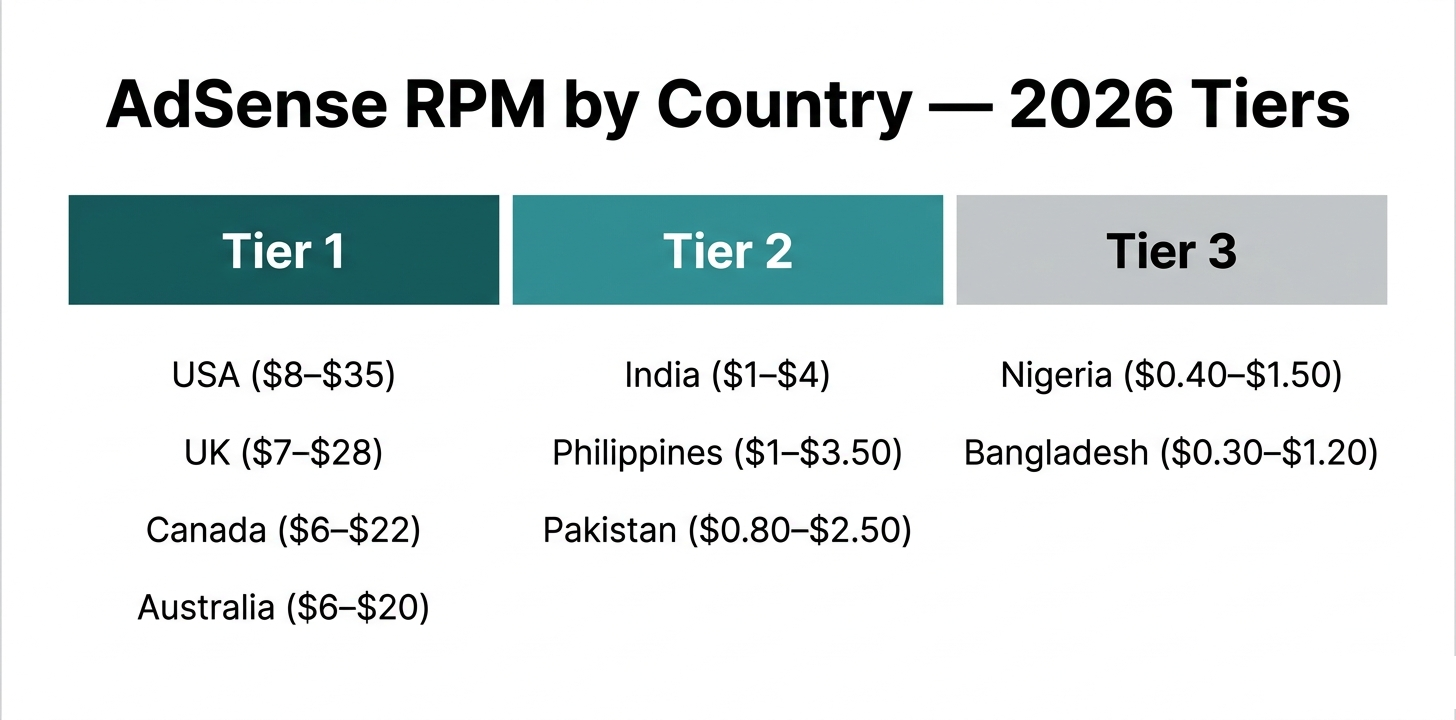
This is the highest-leverage change you can make. Target English-language keywords that US and UK readers search for. Check Google Search Console monthly to see your top traffic countries. If India or Pakistan represents more than 40% of your traffic while you are writing in a monetizable niche, shift your keyword strategy toward queries with higher US search volume. The same content, the same ads, the same site — but 3–5x higher RPM just from the traffic source changing.
See the exact earnings difference by country using our free AdSense Revenue Calculator. Plug in your traffic and switch the country to see how much more you could earn with US-focused content.
Frequently Asked Questions
Does AdSense pay per view or per click?
Both. AdSense pays a small amount per 1,000 ad impressions (CPM) whether or not anyone clicks. It also pays a larger amount each time a visitor clicks an ad (CPC). For most publishers, 70–80% of total AdSense earnings come from clicks, with the remaining 20–30% coming from impression-based CPM payments.
How much does AdSense pay per click in 2026?
AdSense pays publishers approximately 68% of what the advertiser paid per click. The advertiser CPC ranges from $0.10 to $30 depending on the niche, keyword, and audience country. For most blogging and content sites targeting US traffic, the publisher’s effective CPC (what you actually receive) is between $0.10 and $3 per click.
What is a good CTR for AdSense?
A CTR of 1–3% is considered good for AdSense. Below 0.5% usually indicates poor ad placement or mismatched ads. Above 5% can trigger a manual review from Google as it may look like invalid clicks. Aim for 1–2% CTR with well-placed in-content ads and a matching niche audience.
What percentage does AdSense take from earnings?
Google keeps 32% of advertiser spend and pays publishers 68% for content ads. For AdSense for Search (search box ads), the split is different — Google keeps 49% and pays publishers 51%. The 68% revenue share for display ads has been Google’s standard rate since AdSense launched and has not changed in 2026.
How many page views do I need to earn $500 per month with AdSense?
At an RPM of $5 (blogging niche, mixed US and international traffic), you need 100,000 monthly page views to earn $500. At $10 RPM (tech or finance niche, mostly US traffic), you need 50,000 page views. At $2 RPM (general blog, mostly Indian traffic), you need 250,000 page views. Use our AdSense Revenue Calculator to find your specific number.
Does AdSense pay for impressions even if no one clicks?
Yes. CPM ads pay you for every 1,000 ad views, regardless of clicks. The CPM rate is lower than CPC earnings, but it means you earn something from every visitor who sees an ad — not just from those who click. On high-traffic sites with low CTR, CPM income can actually become a meaningful portion of total AdSense revenue.