Reading Time Calculator — Free Tool for Blog Posts, Speeches, and Scripts
How long will your readers actually spend on your page? How long will your speech run when you stand at the podium? How many minutes is your podcast episode going to clock in at?
These aren’t questions you should be guessing at. This free reading time calculator gives you the answer in seconds — paste your text, pick your mode, done.
No email. No account. No limit on how many times you use it.
What This Tool Calculates
Most reading time calculators online do one thing: divide your word count by 200 and call it done. That number is wrong for most use cases, and it doesn’t help you if you’re writing a speech or recording a podcast.
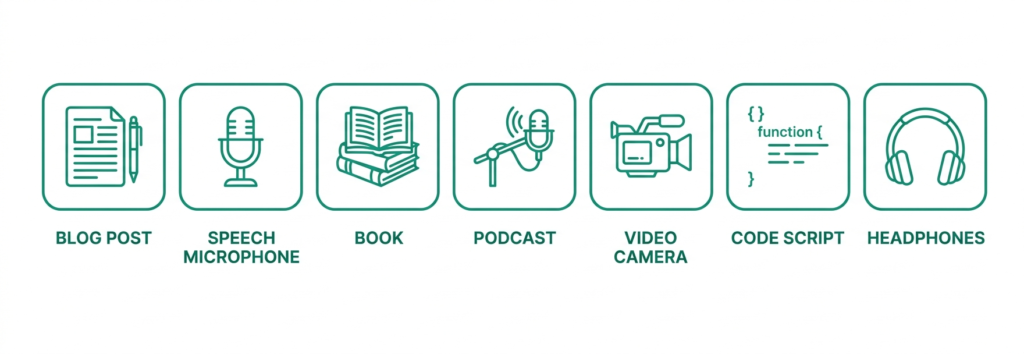
This tool handles seven different content types from a single page:
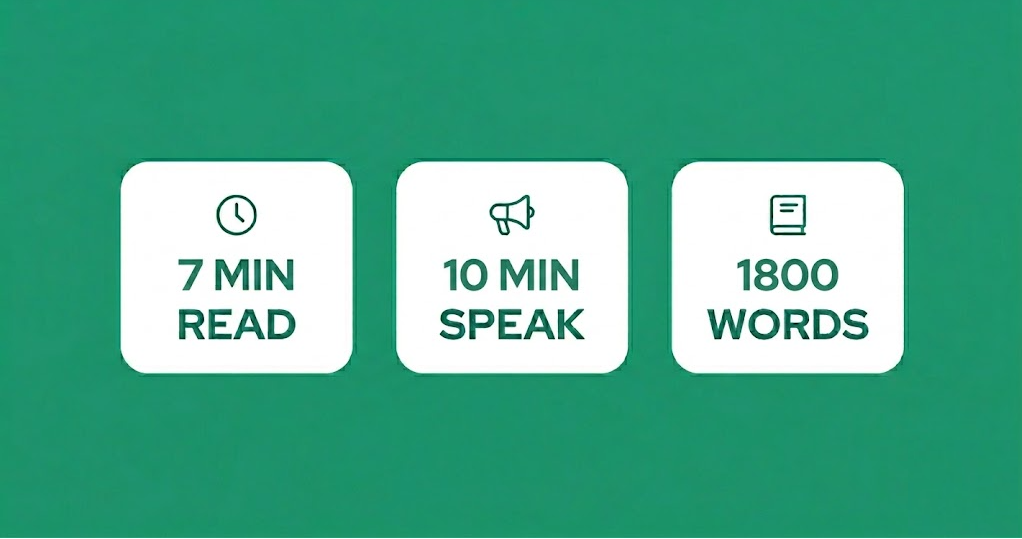
Blog post reading time — The time your readers spend silently reading your article, based on the scientifically established average reading speed of 238 words per minute (Brysbaert, 2019). It also generates a copyable “X min read” badge for your post header.
Speech time calculator — Speaking out loud is significantly slower than reading silently. The average comfortable delivery pace on stage is 130 wpm. Paste your speech script and see your delivery time instantly.
Script time calculator — Voice-over, corporate narration, and radio ad copy each have different natural pacing. The tool adjusts default speeds for each context so your estimate reflects real-world delivery.
Podcast length calculator — Find out how long your episode will actually run from your show notes or full transcript. Most podcast listeners expect 20–45 minutes; use this to calibrate before you record.
Video script calculator — YouTube, Reels, TikTok, and long-form documentary scripts all have wildly different target lengths. See your on-camera duration before you shoot.
Book reading calculator — Calculate the total time to read a book or long manuscript, plus use the reading planner to schedule your daily reading sessions and see how many days it takes to finish.
Audiobook duration calculator — Professional narrators average 9,300 words per finished hour. Estimate your recording time and total listening duration from your manuscript word count.
How to Use the Reading Time Calculator
Using the tool is straightforward, but here are the three paths most people take:
Path 1 — Paste your text. Copy your entire blog post, speech, or script and paste it into the text area. The tool counts your words, characters, sentences, and paragraphs automatically and updates all results in real time as you type.
Path 2 — Enter a word count manually. If you know your word count already — say, 1,500 words — type it into the manual word count field. The tool calculates everything from that number without needing the actual text.
Path 3 — Upload a .txt file. If your content is saved as a plain text file, click the upload button and the tool reads it directly. Your file is never sent to a server; all processing happens in your browser.
Once you have your text in, select your mode using the tabs at the top: Blog Post, Speech, Book, Podcast, Video Script, Script, or Audiobook. Each mode uses speed presets calibrated for that specific context.
Then adjust your speed. If you know your audience reads faster than average, bump the slider up. If you’re preparing for a formal speech where you speak deliberately, dial it down to 110 wpm. The results update instantly.
Reading Speed Reference: What the Numbers Actually Mean
The 238 wpm figure this tool uses as the default silent reading speed comes from a 2019 peer-reviewed meta-analysis by Marc Brysbaert at Ghent University, covering 190 studies and 18,573 participants. It is the most rigorous reading speed estimate in the literature — and notably lower than the 300 wpm figure that gets cited all over the internet, which was based on much smaller, less representative samples.
Here is a practical breakdown of what the speed settings mean:
Slow (150 wpm) — readers who are non-native English speakers, older adults, people reading particularly dense technical content, or anyone reading carefully for comprehension rather than skimming.
Average (238 wpm) — the statistically typical adult reading a non-fiction blog post or article. This is the right default for most bloggers estimating their audience’s experience.
Fast (400 wpm) — experienced readers, academics, or people who skim before reading in depth. Not representative of most web readers, but useful if your audience is expert-level.
For speaking, the ranges work differently:
100–110 wpm — slow, deliberate speech. Eulogies, formal addresses, or any context where every word carries weight.
130 wpm — natural conversational speed. The average for most people during a conference presentation or podcast recording. This is the tool’s default speaking speed.
150–160 wpm — energetic but still clear. Good for enthusiastic presentation delivery or fast-paced YouTube narration.
175+ wpm — rapid delivery. Radio presenters, auctioneers, and people who speak very quickly in informal contexts.
Reading Time Calculator and SEO: Why It Actually Matters for Bloggers
If you run a blog and you’re not thinking about reading time, you’re leaving two measurable things on the table: user engagement and search rankings.
Google doesn’t directly measure whether your readers finish your article. But it does measure time on page, scroll depth, bounce rate, and return visits — all of which correlate strongly with whether your content was the right length for the intent behind the search query.
Short, punchy posts (under 4 minutes) work well for how-to queries, tool pages, and news items. Readers come in, get what they need, and leave satisfied. That low bounce rate signals relevance.
Long-form posts (10+ minutes) work well for pillar content, ultimate guides, and comparison articles. Readers who commit to that length are high-intent, and the time on page signals depth and authority to Google.
The problem is the messy middle: 7–9 minute posts that aren’t quite comprehensive enough to be pillar content and aren’t tight enough to be quick answers. These often have the worst engagement metrics.
Running your post through a reading time calculator before you publish helps you make a deliberate decision. Either tighten it to under 5 minutes or expand it into a proper comprehensive resource. Don’t publish something that accidentally lands in the gap.
The “X min read” badge matters too. Medium popularized it, and readers now expect it. Seeing “6 min read” at the top of an article sets expectations. Readers who choose to click knowing it’ll take 6 minutes are self-selected for intent — they want to read it. Your completion rate goes up, and so does your average time on page.
Use the badge generator in this tool (blog post mode) to copy a pre-formatted badge you can paste directly into your WordPress post or any other CMS.
How Long Should a Blog Post Be? A Practical Answer
This is the question every blogger eventually asks, and the honest answer is: it depends on what the post is trying to do. But there are useful benchmarks.
For SEO-focused blog posts targeting informational keywords, the sweet spot based on current SERP data is 1,200–2,000 words. At 238 wpm, that’s 5–8 minutes. Long enough to be comprehensive on a focused topic; short enough that most readers will finish it.
For pillar content pages — the “ultimate guide” or “complete overview” type posts that anchor your topical authority — 3,000–5,000 words is common. That’s 12–21 minutes of reading. These rank well for competitive keywords because they cover a topic exhaustively, but they need to be genuinely comprehensive rather than padded.
For product roundups and comparison posts, 1,500–2,500 words tends to perform well. Readers want enough detail to make a decision, but not so much that the comparison becomes overwhelming.
For news posts, opinion pieces, and quick how-to articles, 600–900 words is fine. Around 3 minutes. Trying to stretch these artificially hurts more than it helps.
Speech Timing: Why Your Script Length and Delivery Time Are Different
If you’ve ever been surprised by how fast your speech went when you actually delivered it — or how far you ran over — you already understand why a speech time calculator matters.
The disconnect between word count and delivery time comes from three things that are easy to forget when you’re writing:
Pauses. Good speaking has pauses. After a key point. Before a dramatic shift. To let laughter settle. These add 10–15% to your delivery time without adding a single word to your script.
Slides. If you’re presenting with slides, you’re probably not speaking while you click to the next one, wait for an animation, or give the audience time to read a chart. A 20-slide presentation might add 3–5 minutes beyond your word count estimate.
Nerves. Most people speak faster when nervous. If you’re an inexperienced speaker, set your speed to 110 wpm in this tool and write to that length. When nerves kick in, you’ll probably hit 130 wpm anyway.
As a practical rule: write to 80–85% of your time slot when using an average (130 wpm) speaking speed estimate. If you have a 20-minute slot, write to 16–17 minutes. The extra buffer is for pauses, slides, and the audience interaction you can never predict.
Podcast and Video Script Timing: Common Questions
How many words is a 30-minute podcast?
At 145 wpm (the average natural podcast delivery pace), a 30-minute episode needs approximately 4,350 words. Factor in 15–20% extra for unscripted moments, ad reads at different pacing, and intro/outro music. So a scripted 30-minute episode typically needs 3,500–3,700 words of actual scripted content.
How long should a YouTube script be for a 10-minute video?
At 150 wpm on-camera delivery, 10 minutes needs around 1,500 words. But this varies significantly by format. A tutorial with screen recording might have long silences while you demonstrate something. A talking-head editorial video might be wall-to-wall speech. Use the video script mode and set your speaking speed based on your actual delivery style — then measure yourself with a timer against a sample paragraph.
How many words is a 60-second ad or Reel script?
At 150 wpm, 60 seconds needs exactly 150 words. At faster delivery (180 wpm), you can fit about 180 words. At slower, more deliberate pacing (120 wpm), you’re working with around 120 words. Radio and TV copywriters use the rule of thumb of 150 words per 60 seconds for a standard conversational delivery.
How Long Does It Take to Read a Book?
Paste your book text into the tool in Book mode to calculate total reading time. If you don’t have the text, use the word count estimate: most trade paperback novels run 70,000–100,000 words. At 238 wpm, that’s 4.9–7.0 hours of reading time.
The book reading planner at the bottom of Book mode lets you set your daily reading time — say, 30 minutes per day — and calculates how many days it will take to finish. A 300-page novel at 250 words per page (75,000 words) read at 238 wpm takes 315 minutes, or about 5.2 hours. At 30 minutes per day, that’s 11 days to finish.
Audiobook listeners often find this useful too. Professional audiobook narration averages 9,300 words per finished hour — about 155 wpm. The same 75,000-word novel would be an 8-hour audiobook.
Frequently Asked Questions
What is the average reading speed for adults?
Based on a 2019 meta-analysis of 190 studies covering 18,573 participants (Brysbaert et al., published in the Journal of Memory and Language), the average adult reads English non-fiction at 238 words per minute silently. Fiction reads slightly faster at an average of 260 wpm. The average oral reading speed — reading aloud — is 183 wpm. The commonly cited 300 wpm figure has been shown to be an overestimate from older, less representative studies.
How is reading time calculated?
Reading time is calculated by dividing total word count by your reading speed in words per minute. For example, a 1,500-word blog post read at 238 wpm takes 1,500 ÷ 238 = 6.3 minutes, which rounds to 6 minutes 18 seconds. This tool performs that calculation in real time as you type or paste text.
What is the difference between reading time and speaking time?
Silent reading is significantly faster than speaking aloud because your brain processes visual information more quickly than your vocal cords can produce sound. The average silent reading speed is 238 wpm; the average speaking speed is 130 wpm. That means a 1,000-word speech script takes about 7 minutes 41 seconds to deliver, while the same 1,000 words takes only 4 minutes 12 seconds to read silently.
Is my text stored when I use this tool?
No. All calculations happen entirely in your browser using JavaScript. Your text is never sent to any server, never stored, and never accessible to anyone else. You can use this tool with confidential scripts, unpublished manuscripts, or proprietary content without any privacy concern.
How accurate is the reading time estimate?
The estimates are accurate for typical adult readers reading standard content at the selected speed. Individual variation is real — factors like text difficulty, sentence length, unfamiliar vocabulary, and whether the reader is skimming or reading for comprehension all affect actual reading time. The tool’s estimates should be treated as reliable approximations, not precise measurements.
How many words per minute for a speech or presentation?
The average comfortable speaking pace for presentations is 130 wpm. TED Talks average approximately 173 wpm — noticeably faster than typical conference presentations because TED speakers are highly practiced. Slow, deliberate speech (formal addresses, eulogies) runs 100–110 wpm. Fast, conversational delivery can reach 160–180 wpm. Set the speaking speed slider in this tool to match your personal delivery style.
What is a good reading time for a blog post?
Research on content engagement consistently finds that posts in the 3–7 minute reading range have the best completion rates for most topics. At 238 wpm, that’s roughly 700–1,700 words. Pillar content pages can run 10+ minutes and still perform well for high-intent searches, but casual informational posts above 7 minutes often see drop-off. Use this tool before publishing to make sure your post length is deliberate, not accidental.
Can I use this as a words to minutes calculator?
Yes. Simply enter your word count in the manual input field and the tool converts words to minutes instantly using your selected speed. At the default 238 wpm reading speed: 500 words = 2 min 6 sec, 1,000 words = 4 min 12 sec, 1,500 words = 6 min 18 sec, 2,000 words = 8 min 24 sec.
How long does it take to read 1,000 words?
At the average adult reading speed of 238 wpm, 1,000 words takes 4 minutes 12 seconds to read silently. At a slow reading pace (150 wpm), it takes 6 minutes 40 seconds. At a fast pace (400 wpm), it takes 2 minutes 30 seconds. For reading aloud at an average speaking pace (130 wpm), 1,000 words takes 7 minutes 41 seconds.
How long does it take to read 1,500 words?
At 238 wpm, 1,500 words takes 6 minutes 18 seconds to read. This is a common blog post length and sits comfortably in the “ideal reading time” range for most content types.
How long does it take to read 2,000 words?
At 238 wpm, 2,000 words takes 8 minutes 24 seconds. This is on the longer side for a standard blog post — appropriate for in-depth how-to guides and comparison posts, but worth tightening for simpler topics.
Related Tools on FreeToolkit
- AdSense Revenue Calculator — Estimate your monthly AdSense earnings based on pageviews, CTR, and niche CPC
- Robots.txt Generator for WordPress — Create a custom robots.txt file for your WordPress site in under a minute
Reading speed data based on Brysbaert, M., et al. (2019). How many words do we read per minute? A review and meta-analysis of reading rate. Journal of Memory and Language, 109. All calculations are performed client-side in your browser.