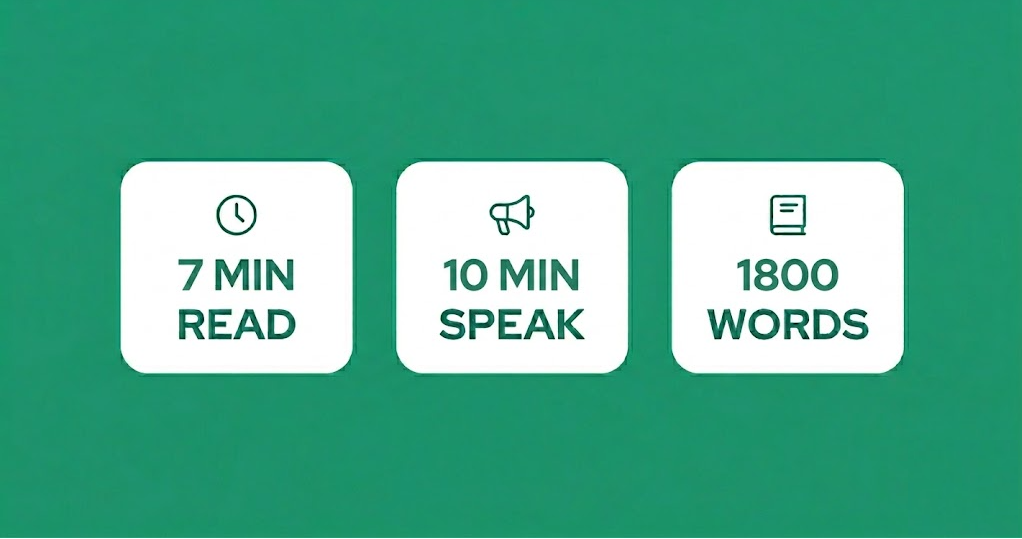
Average reading speed for adults is 238 words per minute (wpm) — the key number for any words-to-time calculation. At this speed, a 1,000-word blog post takes about 4 minutes to read silently and around 6–7 minutes to read aloud. This guide covers average reading speed words to time conversions by age, purpose, and content type — and shows you exactly how to calculate reading time for any word count.
Average Reading Speed by Type
Reading speed varies significantly depending on who is reading and what they are reading. Here are the established benchmarks from academic research:
| Reader Type | Average WPM (Silent) | Average WPM (Aloud) |
|---|---|---|
| Adult (general) | 238 wpm | 150–160 wpm |
| College student | 250–300 wpm | 160–180 wpm |
| Professional / academic | 300–400 wpm | 180–200 wpm |
| Child (Grade 3–4) | 100–130 wpm | 80–100 wpm |
| Child (Grade 6–8) | 150–200 wpm | 130–150 wpm |
| Speed reader (trained) | 400–700 wpm | N/A (not practical aloud) |
| Slow / careful reader | 100–150 wpm | 100–120 wpm |
The 238 wpm figure for average adult silent reading comes from a widely cited 2019 study by Brysbaert published in Psychological Science, which analysed reading speed data from over 190,000 participants across 17 languages. It is the most reliable benchmark available for blog reading time estimates.
Words to Time Conversion Table (Based on Average Reading Speed)
Use this average reading speed words to time table to convert any word count to reading time instantly. Based on 238 wpm (average silent reading) and 150 wpm (average reading aloud):
| Word Count | Silent Reading Time | Reading Aloud Time | Typical Use Case |
|---|---|---|---|
| 300 words | 1 min 15 sec | 2 min | Short social post, intro paragraph |
| 500 words | 2 min 6 sec | 3 min 20 sec | Short blog post, product description |
| 800 words | 3 min 22 sec | 5 min 20 sec | Standard blog post, news article |
| 1,000 words | 4 min 12 sec | 6 min 40 sec | Average blog post |
| 1,500 words | 6 min 18 sec | 10 min | Long-form blog post |
| 2,000 words | 8 min 24 sec | 13 min 20 sec | In-depth guide or tutorial |
| 2,500 words | 10 min 30 sec | 16 min 40 sec | Comprehensive resource |
| 3,000 words | 12 min 36 sec | 20 min | Pillar content, e-book chapter |
| 5,000 words | 21 min | 33 min 20 sec | Long-form guide, white paper |
| 10,000 words | 42 min | 1 hr 6 min | E-book, research report |
For an exact calculation based on your specific text or word count, use our free Reading Time Calculator. Paste your text or enter a word count and choose slow, average, or fast reading speed — you get reading time and speaking time instantly.
How to Calculate Reading Time from Word Count
The formula to convert words to time is straightforward:
Using average reading speed of 238 wpm, the formula to convert words to time is:
Reading Time (minutes) = Word Count ÷ Average Reading Speed (WPM)
For example:
- 1,500 words ÷ 238 wpm = 6.3 minutes (average silent reader)
- 1,500 words ÷ 150 wpm = 10 minutes (reading aloud)
- 1,500 words ÷ 400 wpm = 3.75 minutes (fast reader)
To get seconds, multiply the decimal remainder by 60. So 6.3 minutes = 6 minutes and 18 seconds (0.3 × 60 = 18). This average reading speed words to time formula works for any word count from a single paragraph to a full e-book.
Why Average Reading Speed Words to Time Matters for Bloggers
Understanding the average reading speed helps bloggers in three practical ways:
1. Use Average Reading Speed Words to Time for Your “X Min Read” Badge
Displaying a reading time badge at the top of your post (“6 min read”) reduces bounce rate. Readers know what they are committing to before they start. Medium found that articles with a clearly displayed reading time perform significantly better in engagement than those without, because readers self-select based on available time. Our Reading Time Calculator generates a copyable badge you can paste directly into WordPress.
2. Write the Right Length Using Average Reading Speed Words to Time
Knowing the average reading speed words-to-time ratio (238 wpm) helps you target the right word count for your audience. A quick how-to post should take 2–3 minutes to read (roughly 500–700 words). A comprehensive guide should be 8–12 minutes (2,000–2,800 words). Matching content length to reader intent improves your average time-on-page metric, which is a positive signal for Google.
3. Estimate speech preparation time
The average reading speed words to time ratio changes when you move from silent reading to spoken delivery. If you are converting a blog post into a video script, podcast episode, or presentation, reading aloud speed (150–160 wpm) is the relevant benchmark. A 1,500-word post becomes approximately a 10-minute video script. A 3,000-word post becomes a 20-minute video. This helps you plan content length before you start writing.
Factors That Affect Reading Speed
The 238 wpm average reading speed words-to-time baseline is a population average. Individual reading speed depends on several factors:
| Factor | Effect on Reading Speed |
|---|---|
| Text complexity / vocabulary level | Technical jargon slows reading by 20–40% |
| Font size and line spacing | Small fonts or tight line spacing reduce speed by 10–20% |
| Mobile vs desktop reading | Mobile readers are typically 10–15% slower |
| Native language | Non-native readers average 30–50% slower in a second language |
| Content familiarity | Familiar topics are read 20–30% faster |
| Distractions / environment | Noisy environments reduce reading comprehension and speed |
Understanding how average reading speed words to time varies per reader is why calculators offer multiple WPM presets. The average reading speed words to time ratio shifts based on these factors: Our Reading Time Calculator lets you choose Slow (150 wpm), Average (238 wpm), or Fast (400 wpm) — or set a custom WPM for your specific audience.
Average Reading Speed Words to Time: Quick Reference by Format
| Content Format | Typical Word Count | Reading Time (238 wpm) | Speaking Time (150 wpm) |
|---|---|---|---|
| Tweet / social post | 50–280 | Under 1 min | Under 2 min |
| Email newsletter | 200–400 | 1–2 min | 1–3 min |
| Short blog post | 600–900 | 3–4 min | 4–6 min |
| Standard blog post | 1,000–1,500 | 4–6 min | 7–10 min |
| Long-form article | 2,000–3,000 | 8–13 min | 13–20 min |
| 5-minute speech / video script | 700–800 | 3 min read | 5 min spoken |
| 10-minute speech / video script | 1,400–1,600 | 6 min read | 10 min spoken |
| 30-minute presentation | 4,000–4,500 | 17–19 min read | 27–30 min spoken |
| E-book chapter | 3,000–5,000 | 13–21 min | 20–33 min |
The average reading speed words to time figures above assume standard prose. Technical content and complex vocabulary will increase these times by 20–40%. Need a precise calculation? Our free Reading Time Calculator calculates both reading time and speaking time simultaneously — paste your text or enter a word count and get both outputs instantly.
Frequently Asked Questions
What is the average reading speed in words per minute?
The average adult reads 238 words per minute silently. This figure comes from a 2019 meta-analysis by Brysbaert covering 190,000+ participants. For reading aloud, the average drops to 150–160 wpm. Children read more slowly — around 100–130 wpm in grades 3–4 — while trained speed readers can reach 400–700 wpm.
How do I convert words to time using average reading speed?
Divide your word count by your reading speed in words per minute. For example: 1,000 words ÷ 238 wpm = 4.2 minutes (4 minutes 12 seconds). For speaking time, use 150 wpm instead: 1,000 ÷ 150 = 6.7 minutes (6 minutes 40 seconds). Or use our Reading Time Calculator to do this instantly for any word count.
How long does it take to read 1,000 words?
At average reading speed (238 wpm), 1,000 words takes approximately 4 minutes and 12 seconds to read silently. At slow reading speed (150 wpm), it takes about 6 minutes 40 seconds. At fast reading speed (400 wpm), it takes 2 minutes 30 seconds. Speaking 1,000 words aloud takes approximately 6–7 minutes.
How long does it take to read 2,000 words?
At 238 wpm average reading speed, 2,000 words takes approximately 8 minutes 24 seconds to read. At slow reading speed (150 wpm), it takes around 13 minutes 20 seconds. Reading 2,000 words aloud as a speech takes approximately 13–14 minutes at a natural speaking pace of 150 wpm.
Is 238 wpm a fast reading speed?
No — 238 wpm is the average for adult silent reading. It is considered a normal, comfortable reading pace. Fast readers typically read at 400+ wpm, while speed readers using trained techniques reach 600–700 wpm. Anything below 150 wpm is considered slow for an adult native speaker. Most people reading blog content fall between 200–300 wpm.
How long should a blog post take to read?
Research suggests the optimal reading time for a blog post is 7 minutes, which corresponds to roughly 1,600–1,700 words at average reading speed. However, ideal length depends on your topic — quick how-to posts should be 3–4 minutes (700–900 words) while comprehensive guides can be 10–15 minutes (2,500–3,500 words). Match length to search intent, not a fixed word count target.
What is the difference between reading time and speaking time?
Reading time (silent) is based on ~238 wpm average. Speaking time (reading aloud) is based on ~150 wpm average, since spoken delivery is slower than silent reading. A 1,000-word text takes 4 minutes to read silently but 6–7 minutes to speak aloud. This matters for podcasts, presentations, and video scripts where you need the spoken duration. Our Reading Time Calculator outputs both figures simultaneously.